
Are there MANY WORLDS?

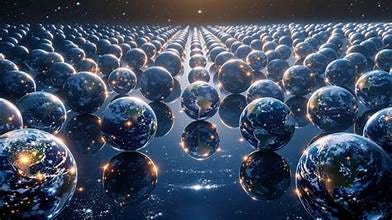
On one hand, we like to think that we’re special. A Course in Miracles talks a lot about “specialness” and “special relationships,” and the pitfalls of those beliefs.
On the other hand, a lot of people get excited by the idea that we’re not alone in this universe and look forward to the day when the “aliens” land on Earth and make themselves known.
There’s a well-developed theory in physics that has captured a lot of attention, called “Many Worlds,” and some recent research has shed new light on the subject. I promised in a recent post to write an essay about it, so here goes….
Technically called the Many Worlds Interpretation (MWI), it is also known as the Multiple Universes theory. And it began when the Double Slit experiment was proving the wave-particle duality and physicists all over the world were trying to make sense of “collapsing the wave function.”
As Erwin Schrödinger used to point out to anyone who would listen, there is nothing in the quantum equations (including his famous wave equation) about “collapse.” That was something that Nils Bohr attached to the theory to “explain” why we only see one outcome of an experiment, not a variety of outcomes. But because we only detect one outcome — one solution to the wave function — that need not mean that the alternative solutions do not exist. In a paper he published in 1952, Schrödinger pointed out the ridiculousness of expecting a quantum superposition to collapse just because we look at it. It was, he wrote, “patently absurd” that the wave function should “be controlled in two entirely different ways, at times by the wave equation, but occasionally by direct interference of the observer, not controlled by the wave equation.”[1]
Schrödinger, of course, is the one who came up with the famous “cat” thought experiment. You place a cat and something that could kill the cat (a radioactive atom, for example) in a box and seal the box. You would not know if the cat were alive or killed by the radioactive atom until you opened the box. Therefore, until the box was opened, the cat was both “dead and alive.” This was a metaphor for subatomic particles which, according to quantum theory, exist in a superposition of states, or multiple simultaneous states, until observation determines a single final state.[2]
In other words, there are two parallel universes, or worlds. In one the cat lives, and in the other one it dies. When the box is opened in one universe, a dead cat is revealed. In the other universe, there is a live cat. But there always were two worlds that had been identical to one another until the moment when the diabolical device determined the fate of the cat. There is no collapse of the wave function.
In 1952, Schrödinger insisted that while his equation seemed to describe different possibilities, that they are “not alternatives but all really happen simultaneously.” This is his quote:
“Nearly every result [the quantum theorist] pronounces is about the probability of this or that or that … happening — with usually a great many alternatives. The idea that they may not be alternatives but all really happen simultaneously seems lunatic to him, just impossible. He thinks that if the laws of nature took this form for, let me say, a quarter of an hour, we should find our surroundings rapidly turning into a quagmire, or sort of a featureless jelly or plasma, all contours becoming blurred, we ourselves probably becoming jellyfish. It is strange that he should believe this. For I understand he grants that unobserved nature does behave this way—namely according to the wave equation. The aforesaid alternatives come into play only when we make an observation — which need, of course, not be a scientific observation. Still it would seem that, according to the quantum theorist, nature is prevented from rapid jellification only by our perceiving or observing it … it is a strange decision.”[3]
Again, in simpler terms, “collapsing the wave function to get a single result” never happens. What actually happens, according to Schrödinger, is that when one result is determined by an observation that puts the particle in a single location, all the other possible locations that were available in the wave prior to the observation also happen simultaneously, each in its own universe. Hence, we end up with multiple parallel universes, or “Many Worlds.”
No one really paid any attention to this, and it was soon forgotten. Until a few years later, in 1955, a PhD student at Princeton named Hugh Everett, apparently unaware of Schrödinger’s theory, developed a mathematical description of this idea for his thesis, and for a paper published in the Reviews of Modern Physics in 1957. Everett pointed out that since no observer would ever be aware of the existence of the other worlds, to claim that they cannot be there because we cannot see them is no more valid than claiming that the Earth cannot be orbiting around the Sun because we cannot feel the movement.
Everett was then hired by the military branch of our government and disappeared into oblivion. But his work was picked up in the late 60s by Bryce DeWitt of the University of North Carolina, who wrote: “every quantum transition taking place in every star, in every galaxy, in every remote corner of the universe is splitting our local world on Earth into myriad copies of itself.”
Physicist John Bell made this observation about the Many Worlds Interpretation:
“The ‘many worlds interpretation’ seems to me an extravagant, and above all an extravagantly vague, hypothesis. I could almost dismiss it as silly. And yet … It may have something distinctive to say in connection with the “Einstein Podolsky Rosen puzzle,” and it would be worthwhile, I think, to formulate some precise version of it to see if this is really so. And the existence of all possible worlds may make us more comfortable about the existence of our own world … which seems to be in some ways a highly improbable one.”
This whole Many Worlds Interpretation may seem to be totally far-fetched, but it in fact has been instrumental in the development of quantum computing, for example. And two studies published in 2025 seem to validate the whole idea. Briefly, here are some excerpts from a recent article from Yahoo News….
“The first [study] was a paper published in Monthly Notices of the Royal Astronomical Society, which looked at images of more than 250 distant galaxies captured by the James Webb Space Telescope. It showed that roughly two-thirds of the galaxies rotate in a clockwise direction, while the rest rotate counterclockwise. On a scale as large as the universe, the split should theoretically be even. The fact that a majority of galaxies rotate in a specific direction could imply that the universe itself is rotating. There’s no clear explanation for this, but it would fit with the behavior of a black hole.
“Another study published in Physical Review D went a step further by proposing a new model for the formation of the universe that fits with the theory of “Black Hole Cosmology.” It proposes that the gravitational collapse of a black hole can also create a “bounce” back, switching from compressing matter to expanding matter. In this model, the Big Bang was not the beginning of all things, but rather one such bounce. It actually makes surprising sense if you think about it. The Big Bang came from a singularity, and the gravitational collapse that creates black holes also results in a singularity. What if the singularity that preceded the Big Bang was itself created by gravitational collapse?
“If our universe is inside of a black hole, it raises a couple of huge questions. First of all, what is that black hole contained within, and second, what is contained within the black holes in our own observable universe? 20 years after Raj Kumar Pathria published his groundbreaking paper outlining Black Hole Cosmology, physicist Lee Smolin published a book called The Life of the Cosmos, in which he argues that the formation of every black hole also creates a new universe. Therefore, our universe is contained within a black hole in another universe, and every black hole that we can observe contains another universe within it.
“Smolin proposed that each time a new universe is created inside of a black hole, a few random variations occur to make that universe unique from all the others. This mirrors Charles Darwin’s theory of evolution, in which random genetic variations set a precedent for future generations. Through the force of “cosmological natural selection,” our universe accrued traits like stars, and ultimately, life itself.
“It’s impossible to firmly prove or dismiss the theories of black hole cosmology and cosmological natural selection with the tools and data we have now, but if it were true, it would help tie up some loose ends in our cosmic knowledge, like the evidence that dark matter could predate the Big Bang. It also opens up a much looser view of the cosmos, one where laws are not as rigid as we once believed.”[4]
There are an estimated 40 Billion Billion (40,000,000,000,000,000,000) black holes in our universe alone. That could mean 40 Billion Billion different universes inside those 40 Billion Billion black holes. And the black hole that is home to our universe would be part of another universe, which might also have 40 Billion Billion black holes. Now THAT’s what I call “Many Worlds.” And it leaves a lot of room for all possibilities to happen in different universes when there is a choice to be made about the location of a particle. “The formation of every black hole also creates a new universe.”
On one hand, it’s a theory that may make some of us feel a little better, knowing that the decisions and choices we make are not “written in stone,” but all the other choices we didn’t make at the time also “came true” in another universe. It would seem to lessen the “guilt” we might feel about the choice we DID or didn’t make.
On the other hand, it makes it a lot harder to think we’re “special.”
[1] https://thereader.mitpress.mit.edu/the-many-worlds-theory/
[2] Philip Ball - New pursuit of Schrödinger’s cat, Archived 2018-07-10 at the Wayback Machine
[3] Gribbin, John. Six Impossible Things: The Mystery of the Quantum World
[4] https://www.yahoo.com/news/articles/universe-stuck-inside-black-hole-121700748.html