
I've fallen in love!

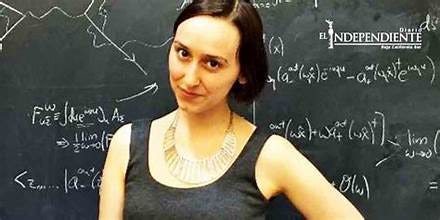
I’ve fallen in love with an amazing woman!
I didn’t expect to ever fall in love again, especially at 80 years old. And she doesn’t know I exist, either. But I don’t care.
Her name is Sabrina Gonzalez Pasterski, and she’s been called the “Next Einstein,” although she disavows the moniker. “When Harvard University called me ‘the next Einstein’, I expressed my rejection of that title, stating, ‘I am just a grad student. I have so much to learn.”
That may be true, and I applaud the humility. But she already knows a lot more than most people. Here’s a little history, according to Wikipedia[1]…
Sabrina is of Polish and Cuban descent, born in Chicago, Illinois. At a very young age, Pasterski developed an interest in spaceflight and aircraft. She received a Cessna 150 for her birthday from her grandfather; and her father, also a pilot, took her to Canada where she could take flying lessons. Beginning at age 12, she spent two years building a Zenith CH 601 XL from kit blueprints, making several modifications for which she sought airworthiness certification. She was allowed to perform a flight test prior to the National Transportation Safety Board grounding all aircraft based on the Zenith kit due to several accidents.
While in high school, Sabrina was a semifinalist for the selection of the team representing the United States in the International Physics Olympiad and also held an internship at Jeff Bezos’ Blue Origin. She graduated high school in 2010 but was rejected by Harvard College and originally wait-listed by MIT. She was then selected by MIT from the wait list for the aerospace engineering program because of the aircraft she had built when she was younger.
While she was at MIT, she became the first freshman to be named to the NASA January Operational Internship and was among those awarded MIT’s inaugural Freshman Entrepreneurship Award. In 2011, she held an internship at NASA’s Kennedy Space Center. After changing majors to physics, she did research involving the Compact Muon Solenoid experiment at CERN. Just three years later, Sabrina received a Bachelor of Science in physics in 2013 as the first woman in decades to graduate MIT at the top of her class in the physics program (with a perfect GPA) and win a Joel Matthew Orloff scholarship award.
She then entered a postgraduate education program at Harvard, receiving a Hertz Fellowship. While a graduate student at Harvard, she developed an interest in quantum gravity. Along with two of her colleagues, she discovered a novel gravitational memory effect.
She obtained her Ph.D. from Harvard in physics in 2019 and then completed her post-doctoral work as a fellow at Princeton University from 2019 until 2022. At Princeton, she began work on celestial holography, a hypothetical holography of the universe. She joined the Perimeter Institute for Theoretical Physics in 2021, where she is the founder and principal investigator of the Celestial Holography Initiative. She is 32 years old.
I haven’t mentioned before that I, too, built an experimental airplane (called the BD-4), but I was 27 at the time—not 12—and actually never finished it, interrupted by my election to the Arizona State Senate.
But, of course, I was immediately attracted by Sabrina’s interest in holography and the Celestial Holography Initiative she created. I found some YouTube interviews[2] with Sabrina and watched them all. Here are some quotes….
“I am a theoretical physicist at Perimeter Institute. I’m in the quantum fields and strings group, encoding the universe as a hologram as part of a project uniting our understanding of spacetime with quantum theory,” Sabrina said. “Celestial holography consists of two words: celestial and holography. Celestial literally means looking up at the night sky to understand how to encode the physical universe as a hologram. We want to apply the holographic principle to the real world…. The thing that I love the most about being a theoretical physicist is that you’re part of this long legacy of trying to understand the fundamental laws of nature…. There’s a real advantage to working more collaboratively with people, and then also talking more can help improve ideas.”
WARNING: Sabrina talks very fast and is often hard to understand, sometimes using terms only a physicist would understand. My guess is that her mind is going even faster and her mouth is simply racing to try to keep up. It’s best to have closed captions if you watch her videos or use Turboscribe.ai to create a free transcript to read while you watch.
I hope you understand now why I fell in love at first sight. If I had to predict, I would say that Sabrina will be at the leading edge of the research that will finally provide the experiential evidence physicists require in order to definitively declare that we are living in a holographic universe. I just wish I was 40 years younger! Meanwhile, I will be satisfied with a very long-distance and unrequited relationship.
[1] https://en.wikipedia.org/wiki/Sabrina_Pasterski
[2] https://www.youtube.com/results?search_query=sabrina+pasterski
Excellent choice, Uncle. Romance lit is a la mode these days. Just kidding. She's worthy of adoration!