
The Double Slit Experiment - Part 1

I think it’s time to take a step back and look at some very basic information on which the holographic universe and the simulation hypothesis are based.
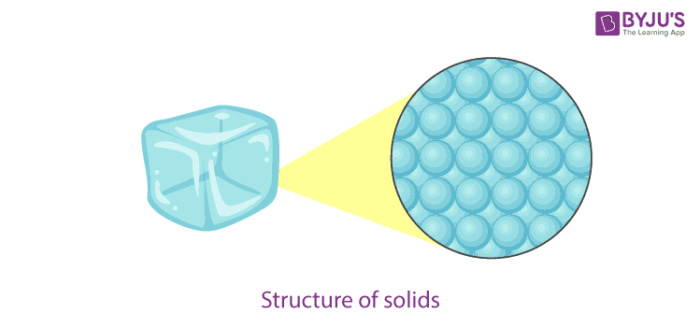
Put very simply, we have believed for years that matter is solid, made up of particles like electrons. Now we know that simply isn’t true—that electrons are only particles some of the time, and the rest of the time they are waves containing all the different locations the electron can occupy as a particle once it is observed. This is called the wave-particle duality.
How do we know this? From a very famous experiment, first performed in 1801 and called the “interference experiment,” in which Thomas Young showed how light acted like a wave under certain conditions. This was in direct opposition to Isaac Newton’s corpuscular theory of light, which said that light is emitted from a luminous body in the form of tiny particles.
Since then, this same experiment (now called the Double Slit Experiment) has been repeated hundreds, maybe thousands of time, always with the same result: That an electron acts like a particle when it is being observed and like a wave when it’s not.
I know that’s hard to wrap one’s brain around. So, let’s examine the experiment more specifically….
We’re going to start by taking small pieces of matter, like little BB’s, and shooting a stream of them out of a gun against a barrier that has a single slit in it.
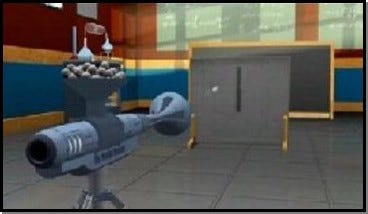
Behind the barrier is a sensitive screen, so when a BB hits it, it makes a mark, like this….
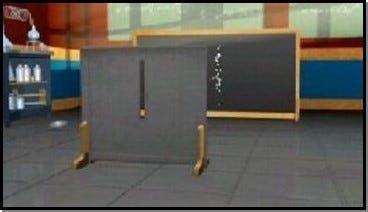
Most of the BB’s hit the barrier, but the ones that go through the slit hit the screen and make a pattern just like the shape of the slit.
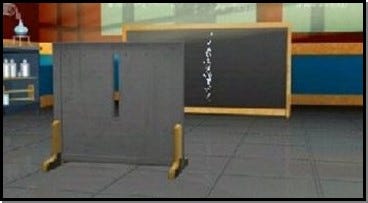
All that makes perfect sense. So now we’ll add a second slit in the barrier…
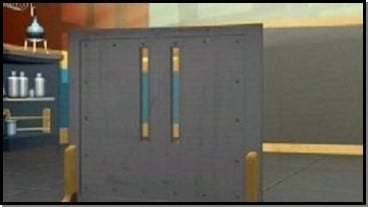
…and shoot the BB’s at it again; and we get what we’d expect to get: a pattern of two slits on the screen.
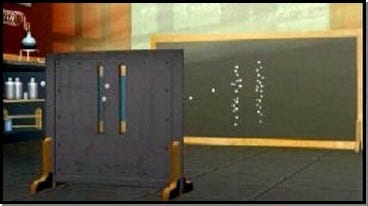
Okay, so far so good. Now, what would happen if we sent waves of water toward the screen instead of firing BB’s at it?
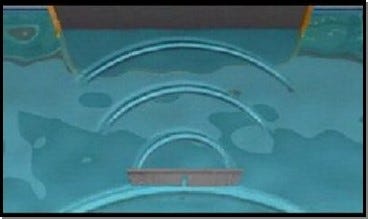
With just one slit in the barrier, part of the wave goes through the slit and forms a pattern on the screen that looks a lot like the BB pattern with only one slit. The most intensity on the screen is where the top of the wave hits, directly in line with the slit.
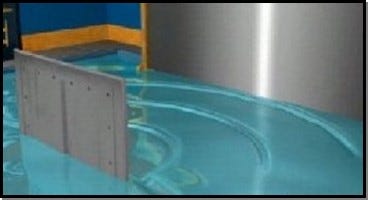
But if we put a barrier with two slits in it between the waves and the screen, a completely different thing happens.
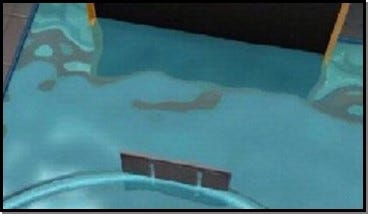
When the water goes through both slits, the new waves created by the slits on the other side of the barrier hit each other on the way to the screen.
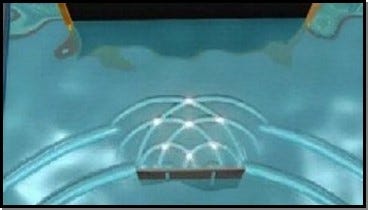
When the top of one wave hits the bottom of another wave, they cancel each other out. This is called “destructive interference.” You can easily see this when you drop two pebbles in a pond some distance apart and watch what happens when the ripples meet. So, when we send waves through a barrier with two slits, we get what is called an “interference pattern” on the screen, like this….
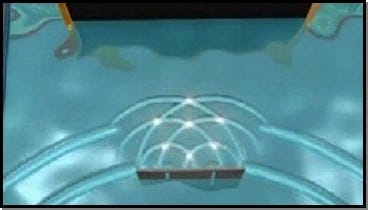
The bright lines on the screen are where the tops of the waves joined each other (constructive interference) and then made it to the screen. The dark spaces in between are where the top of one wave hit the bottom of another wave (destructive interference), canceling them both out and never making it to the screen.
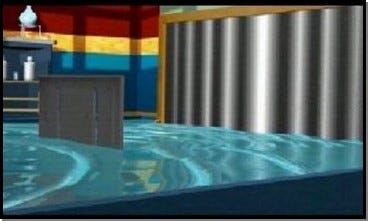
So, when we send “particles of matter,” like the BB’s, through two slits, we get two definite patterns on the screen that look like the slits they came through. When we send “waves” through two slits, we get an interference pattern on the screen.
In the next post, we’re going to substitute electrons for the BBs. Since electrons are considered “particles” like the BBs, we should get the same results. But do we?