
Video Games

In my last post, we said that electrons—the things that make up our “reality”—are only particles when they are being observed, and the rest of the time they exist as a wave of possibilities where they may eventually be located when observed.
If you’ve never played a video game, you really should, at least once. Because a video game is very much a reflection of how our universe works. Here’s what I mean….
When you play a typical video game these days, the point is usually to perform some task someplace, earn a reward for completing that task, and then move on to the next place and task. So, you might find yourself in a room like this….
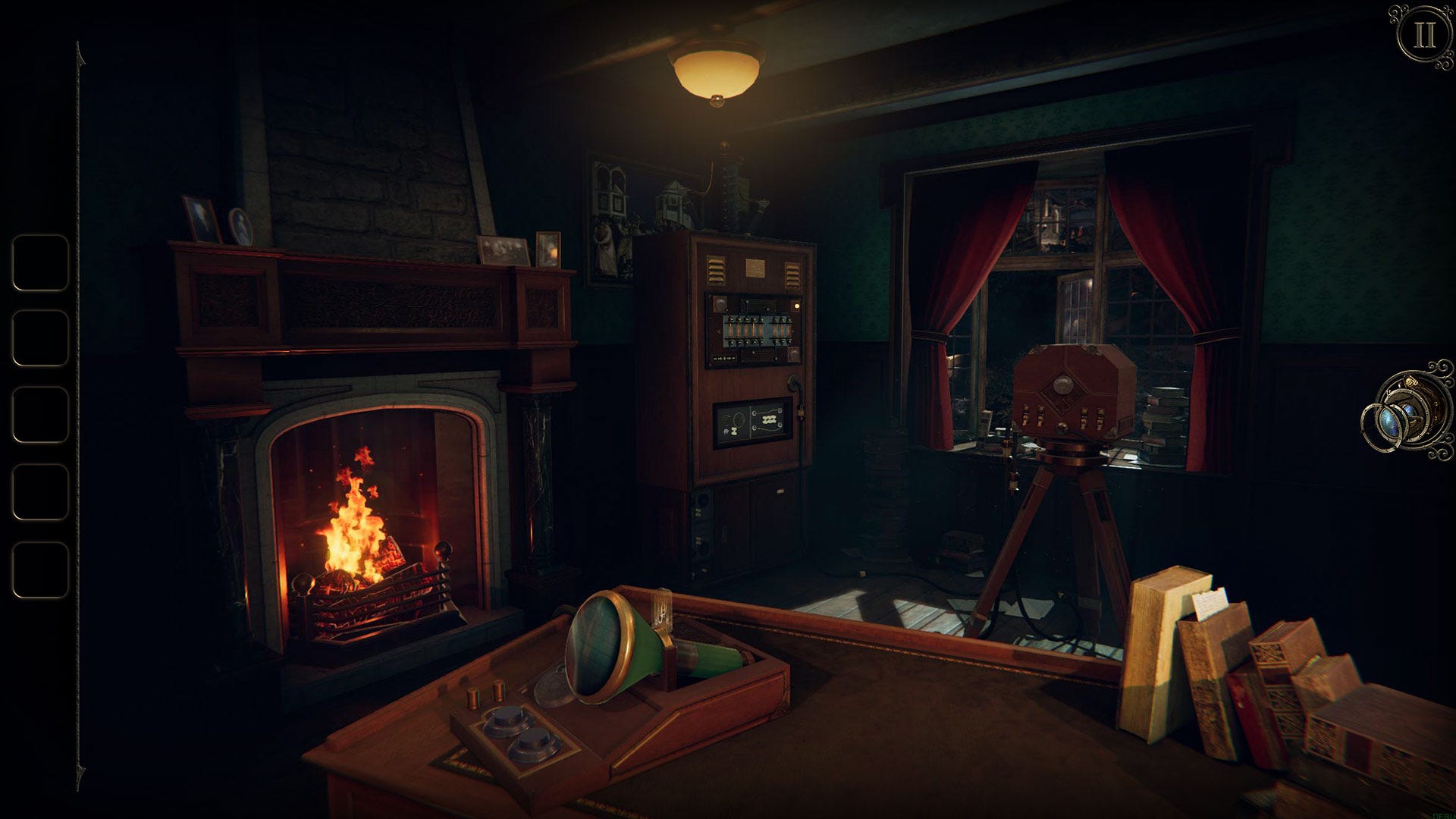
… and have to solve some clues to move on. But when you’ve solved those clues and find yourself in the next room, this first room no longer appears on the screen. Where does it go?
Basically, it disappears, at least for now, and actually for as long as you’re not in it. If you should turn around and go back into that room, it will take over your screen again and look exactly like it did when you were first there. Leave the room again and it disappears again.
My point is pretty obvious…. As long as you are observing the room you’re in, it appears on the screen. The minute you stop observing it and start observing a different room, the first room no longer exists, essentially.
But is that true that it “no longer exists”? No, not really. What happened is that the computer code that creates that room went back to just being certain lines of code lying dormant among all the other lines of code that make up the video game—like all the other rooms you will eventually get to as you progress through the game. But if you walk back into that first room (observe it again), those lines of code become active again.
Yes, this is exactly how physics is saying our “reality” works. As long as you are observing something in your experience, you are collapsing the wave function of those particular waves which creates what appears to you to be solid matter. But if you stop observing it, those particles of matter turn back into waves and return to The Field. If you observe that same thing once again, you will be collapsing the same wave function and it will appear as you first observed it.
So, this brings up two basic questions. One, who chooses which waves to collapse into matter, creating the experience of “reality” that we have? I tried to answer that question in my post called The Simulation Hypothesis (March 15) which, put simply, was that it isn’t “God,” and it isn’t you. Plato called it a “demiurge,” and I might spend more time on that later in another post. But please feel free to go to my archives and read that post.
Moving on, the second question is: Have I completely lost it? I’m suggesting that “as long as you are observing something in your experience, you are collapsing the wave function of those particular waves which creates what appears to you to be solid matter. But if you stop observing it, those particles of matter turn back into waves and return to The Field.”
Yes, you should lock me up in a psych ward for suggesting that the part of the room that is behind you and you can’t see as you read this doesn’t actually exist as matter right now—you’re certain it DOES exist, or are you?—and if you turn around and observe it, you will collapse the wave function and that part of the room will appear again just like it was.
But if you lock me up, you’re going to have to lock up a lot of prominent physicists along with me. Let me remind you of what physicist Nick Herbert (best known for his book Quantum Reality) said…. that this sometimes causes him to imaginet, behind our back, the world (where we are not looking and cannot observe) is always “a radically ambiguous and ceaselessly flowing quantum soup.”[i] But whenever we turn around and try to see the soup, our glance instantly freezes it and turns it back into “reality.” Herbert believes this makes us all a little like Midas, the legendary king who never knew the feel of silk or the caress of a human hand because everything he touched turned to gold. “Likewise humans can never experience the true texture of quantum reality because everything we observe turns to matter.”[ii]
To take this to its logical conclusion, Paris, France, doesn’t exist because you’re not observing it at the moment. “Logical conclusion?” No, CRAZY conclusion.
So, let’s modify this slightly, to say that Paris, France, DOES exist in wave form in The Field; it just doesn’t exist as solid matter in your present experience because you aren’t observing it. It’s like the room that you left in your video game that disappears back into the computer code that created it, lying dormant along with the rest of the code required for the video game to work while you move on to the next room, which you then create by observing it.
I understand your hesitation. This is truly difficult to wrap your head around. I wrote a post called The Most Difficult Thing to Accept (March 13), explaining that “in addition to being “receivers,” our eyes are “projectors.” But maybe I was wrong. Maybe this concept that our “reality” only exists as solid matter when we’re observing it (or projecting it!)… maybe that’s even more difficult to accept.
Be that as it may, it’s what quantum physics is telling us. So maybe we better get used to it and adjust our thinking and behaviors accordingly.
There is a very good movie (IMHO) called The Thirteenth Floor (1999, with Craig Bierko) that demonstrates this concept very well as Bierko drives to where “reality” stops and the waves begin. Give it a watch….
[i] Herbert, Nick. “How Large is Starlight: A Brief Look at Quantum Reality,” Revision 10, no. 1 (Summer 1987), pp. 31-35
[ii] Ibid.